 BinDot
How to Remember Which Bin Goes Out Each Week
The day is easy. It is the same every week. The hard part is which bin.
November 21, 2026 by the BinDot team
The short answer
The easiest way to remember which bin goes out each week is to tie your schedule to one collection date you know for sure, then let something outside your head keep count. A reminder that repeats every 2 weeks, a marked calendar, or a Home Screen widget that shows the next bin will all do it. Guessing from the neighbours works until the week they guess wrong.
Why alternating weeks are so easy to lose track of
Many towns and regional districts collect garbage every week but take recycling, yard waste or organics every other week. The truck comes on the same weekday each time, so the day itself sticks in your head. What changes is which cart goes with the garbage, and that is the part memory handles badly.
Two weeks is just long enough to forget what happened last time. Did the blue lid go out last Thursday or the Thursday before? A holiday, a trip away or one missed pickup is enough to lose the thread. Then you look down the street at dawn and see both colours of lid at the curb, because everyone else is guessing too.
The fix is not a better memory. It is a single fact you trust, plus a system that does the counting for you.
Start with your real schedule
Before any trick, get the schedule from the people who run the trucks. Your municipality or regional district publishes it, usually as a collection calendar, an address lookup on its website, or an app. Write down five things:
- Your collection day.
- Which streams go out every week, usually garbage.
- Which streams go out every other week, and which of them alternate with each other.
- Any seasonal stream, such as yard waste, and the months it runs.
- The time carts must be at the curb.
Here is how that looks in the Central Okanagan, where the Regional District of Central Okanagan (RDCO) runs garbage and yard waste collection and Recycle BC runs curbside recycling:
- Garbage is collected every week.
- Recycling is collected every other week, alternating with yard waste.
- Yard waste is collected every other week from March to December only.
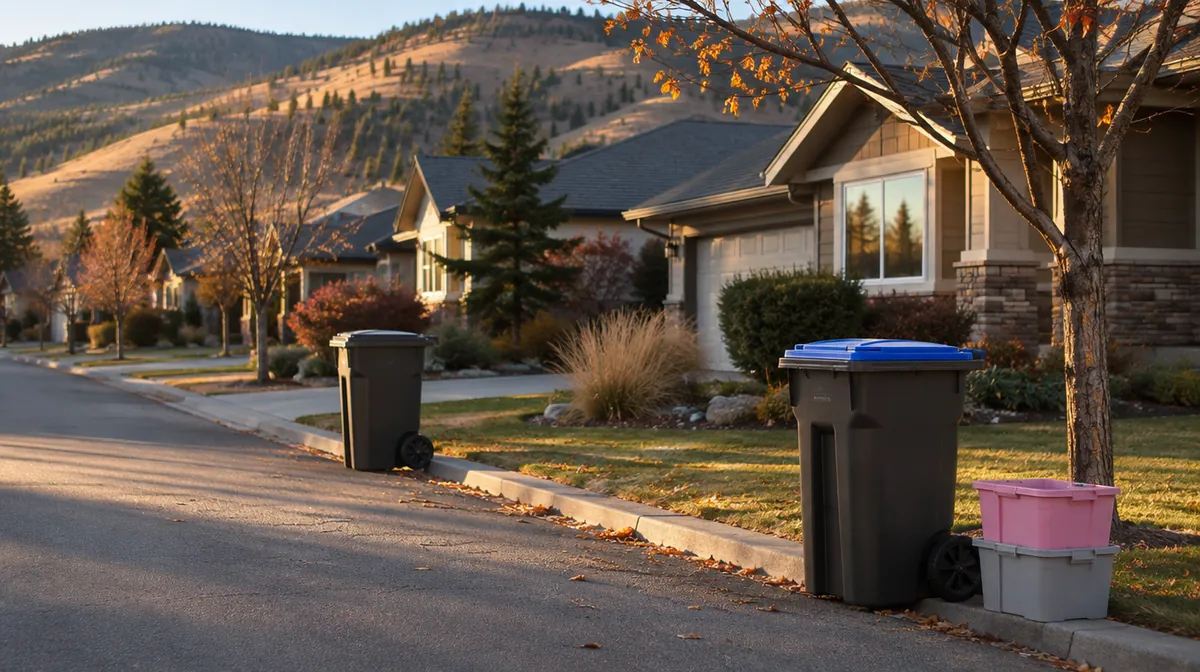
- Paper and plastic packaging go in the blue-lidded cart. Flexible plastics go in a pink box and non-deposit glass bottles and jars in a grey box, picked up on the same day as the recycling cart.
- Carts and boxes must be at the curb by 7 a.m. on collection day. The RDCO asks people to avoid putting them out earlier, to reduce wildlife conflicts.
Recycle BC took over curbside recycling in the Central Okanagan on May 1, 2026, so an old recycling calendar from before that date is worth replacing. Recycle BC's own app can show your collection day and send pickup notifications.
Six ways to remember which bin goes out
Pick one or two of these. The best one is the one your household will still be using in March.
1. Anchor on one date you know
Find one collection day you are certain of, for example from your calendar or the last time the recycling truck came. Write it down as a fact, for example "Recycling: Thursday, December 3." With a 2-week rhythm, every 14 days after that is a recycling day, and the Thursdays in between are the other stream. Counting in 14s from a known date beats trying to remember what you did last week.
2. The odd and even week trick, and the year it breaks
Most phone calendars can show week numbers. If your recycling always lands on even-numbered weeks, "even means recycling" is a tidy rule. It has one weak spot. A year sometimes has 53 numbered weeks instead of 52, and 2026 is one of them because it started on a Thursday. Week 53 runs from December 28, 2026 to January 3, 2027, and the next week is week 1. That puts two odd weeks back to back.
Your collection does not care about week numbers, so it keeps its 2-week rhythm and your rule quietly flips. If you use this trick, re-check it against your local calendar every January. Some calendars also number weeks differently, so compare the number your phone shows with a known collection day before you trust it.
3. A reminder that repeats every 2 weeks
Most phone calendars and reminder apps can repeat an event every 2 weeks. Set up one reminder per stream:
- Garbage, repeating every week.
- Recycling, repeating every 2 weeks, starting on a confirmed recycling day.
- Yard waste or organics, repeating every 2 weeks, starting on the other week.
Time it for the evening before if your carts have to be out early in the morning. The drawbacks: once you dismiss a notification it is gone, you cannot glance at it on Saturday to see what is next, and a plain repeat does not know when a seasonal stream stops for the winter.
4. A calendar on the fridge
Many local governments publish a printable collection calendar. The RDCO, for example, publishes its garbage and yard waste calendar online. Print it, highlight the recycling weeks in one colour and the other stream in another, and stick it where everyone in the house will see it. It works well for families and housemates who share the job. It does need replacing every year, and it is no help when you are away and a neighbour is putting the bins out for you.
5. A magnet you flip
A low-tech option: a two-sided fridge magnet, one side in each bin's colour. After the truck comes, flip it to show the bin that goes out next time. It takes two seconds, and anyone in the house can read it. Its only weakness is the day someone forgets to flip it.
6. A widget that shows the next bin
This is the job BinDot was made for. You answer two questions, your collection day and which bin goes out next, and BinDot keeps count from there. Its Home Screen widget shows a small dot in the colour of the next bin. On collection day the whole widget fills with that colour, and it changes by itself at midnight. If two or three bins go out on the same day, each one gets its own band.
BinDot also sends one reminder before each collection, 2 days ahead unless you change it to the day itself or 1 or 3 days before, at the time you choose. Each bin can be set to every week or every 2 weeks, and you can add up to 8 bins with their own names and colours. In the Central Okanagan it can suggest the bins used there, from garbage and recycling to yard waste, glass and flexible plastics, each with that area's rules under What goes in. There is no account, and your bins stay on your phone. It is free for 14 days, so you can see a full 2-week cycle before deciding.
What to do after a holiday, a trip or a missed pickup
- Holidays. Check your local calendar for any change around a statutory holiday rather than assuming the truck runs as usual or a day late. Rules differ from place to place.
- A missed pickup. A pickup the truck missed does not move your schedule. Report it so it can be sorted out. In the Central Okanagan, missed garbage and yard waste collection goes to E360S at 250-868-3211 or info-bc@e360s.ca, and Recycle BC lists recyclebc@e360s.ca or 250-412-5336 for recycling service questions.
- Back from a trip. Do not guess from memory. Go back to your anchor date, or check the calendar, before the next collection day.
- A real change to your schedule. New calendars, route changes and a new recycling provider all happen. When they do, pick a fresh anchor date and update your reminders. In BinDot, open the bin and change its next collection, which takes a few seconds.
A week-by-week example
Say your collection day is Thursday, and you know recycling goes out on Thursday, December 3. With garbage every week and recycling alternating with yard waste, the next few weeks look like this. It is an illustration of the pattern, not an official schedule, so always confirm dates and holiday changes with your own calendar.
| Thursday | Goes out |
|---|---|
| December 3 | Garbage, recycling cart, pink and grey boxes |
| December 10 | Garbage, yard waste |
| December 17 | Garbage, recycling cart, pink and grey boxes |
In the Central Okanagan, yard waste stops after December and starts again in March, so in January and February the weeks between recycling pickups are garbage only. Recycling keeps its every-other-week rhythm right through the winter. That seasonal gap is exactly where a simple "the other bin" habit goes wrong, and it is why it helps to keep each bin on its own schedule.
Frequently asked questions
What is the easiest way to remember bin day?
Anchor your schedule on one collection date you know for sure, then let something outside your head keep count: a reminder that repeats every 2 weeks, a marked calendar on the fridge, or a Home Screen widget that shows the next bin. Relying on memory or on the neighbours is what usually goes wrong.
How do I know if it is recycling week or garbage week?
Check your municipality's or regional district's collection calendar or lookup tool for your address. In many places garbage goes out every week and recycling every other week, so the question is really whether this is a recycling week. Count forward in 14-day steps from any recycling day you have confirmed.
Why does my odd or even week rule stop working in January?
Some years have 53 numbered weeks. 2026 is one of them, so week 53 (December 28, 2026 to January 3, 2027) is followed by week 1, and two odd weeks come in a row. Your collection keeps its 2-week rhythm, but an odd or even rule flips. Re-check it against your calendar every January.
Do I need an app to remember bin day?
No. A repeating reminder or a paper calendar works if you keep it up to date. An app or widget helps when you have more than one bin on alternating weeks, when several people share the job, or when you want to see the answer without opening anything.
What time should bins go out?
Follow your local rule. In the Central Okanagan, carts and boxes must be at the curb by 7 a.m. on collection day, and the Regional District asks people to avoid putting them out earlier, to reduce wildlife conflicts. Other areas set their own times, so check your local guide.
Blue week or green week?
BinDot puts the answer on your Home Screen. Try it free for 14 days. No sign-up, no card.


Sources
- Curbside collection, Regional District of Central Okanagan.
- Pick up schedule and maps, Regional District of Central Okanagan.
- Central Okanagan, Recycle BC.